

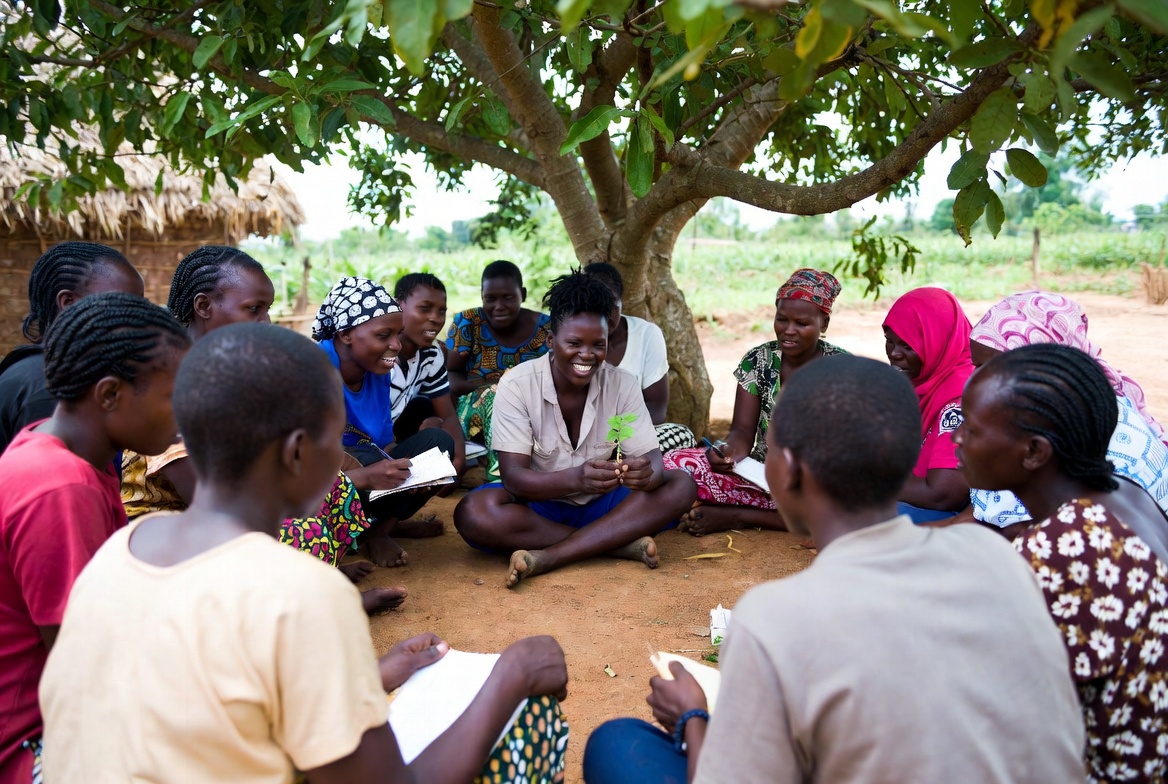
Building Power from the Ground Up — How The Good Ground Initiative is Transforming Rural Uganda Through Women, Youth, Education & Climate Resilience
The Good Ground Initiative (GGI) equips ultra-poor rural women, youth, and refugees in Eastern and Central Uganda with climate-smart livelihoods, inclusive education through UgLearn, and community-led resilience — so families can earn, learn, and thrive.
Building Power from the Ground Up
How The Good Ground Initiative is transforming rural Uganda through women, youth, education, and climate resilience
In rural Uganda, opportunity is rarely missing because people lack ambition. It is missing because land is small, cash cycles are slow, schools are under-resourced, climate shocks are frequent, and digital tools rarely reach the last mile.
The Good Ground Initiative (GGI) was founded to close that gap — not with one-off handouts, but with practical systems: women-led poultry and farming clusters, climate-smart gardens, mushroom enterprises, and UgLearn, our offline-first digital learning platform.
We work primarily in Namayingo, Busia, Tororo, Mayuge, Iganga, and Wakiso (Kawanda), with intentional inclusion of refugee women and families who share the same need for dignity, income, and skills.
Who we are
The Good Ground Initiative is a community-rooted non-profit organisation registered in Uganda. Our mission is to empower ultra-poor women, youth, and underserved learners through sustainable livelihoods, inclusive education, and climate resilience.
We believe:
- Women who control income change household nutrition and school attendance.
- Youth who gain skills stop waiting for jobs that never come — they create options.
- Education that only works online excludes the majority of rural learners.
- Climate adaptation must sit inside daily livelihoods, not in separate workshops.
GGI is the organisational home for field programmes (Mama Kuku, Mama Shamba, mushroom enterprises) and for UgLearn — the digital layer that carries learning, skills, and opportunity beyond the classroom.
Our flagship programmes
1. Mama Kuku — Women turning poultry into power & prosperity
Mama Kuku is a women-led poultry model. Groups of about 10 women form a cluster and receive startup support: broiler chicks, basic housing materials, feed, vaccines, and hands-on training in biosecurity, feeding, and marketing.
Birds reach market weight in roughly 5–6 weeks, creating a fast cash cycle for families who cannot wait a full farming season. Profits are managed transparently within the group — with portions reinvested, shared among members, and saved for emergencies or growth.
Why it works in our communities:
- Low land requirement — possible in small backyards
- High local demand for chicken meat
- Builds on women’s existing knowledge with modern techniques
- Improves household protein and children’s nutrition
- Creates a natural link to gardens through poultry manure
Pilot clusters in Namayingo and partner districts have already shown that participating women can earn meaningful additional income per cycle — money that goes to school fees, healthcare, and food. Congolese and other refugee women have been integrated into early clusters so empowerment is not limited by nationality.
2026 direction: scale to more clusters, strengthen local markets, and expand value-chain steps such as feed awareness and group marketing.
2. Mama Shamba — Women turning soil into strength, sustainability & prosperity
Mama Shamba is our climate-smart agriculture initiative for ultra-poor women and youth. Clusters receive quality vegetable seeds, basic irrigation support where possible, and intensive training in:
- Raised beds and mulching
- Water harvesting
- Integrated pest management
- Crop rotation
Produce is harvested on short cycles and sold in local markets, to institutions, or through group marketing.
The circular link with Mama Kuku is deliberate: poultry manure from chicken projects is used as organic fertiliser in the gardens, boosting yields. Excess manure can also be sold — another income stream for the group.
Mama Shamba matters because it:
- Needs relatively little land
- Delivers quick returns through short growing cycles
- Improves household food security and nutrition
- Builds climate resilience against irregular rains
- Gives women and youth marketable skills with dignity
Refugee women from Congolese and Sudanese backgrounds have been welcomed into groups. Our goal is to expand clusters and, over time, add fruit trees, simple value addition (drying, packaging), and stronger market linkages.
3. Mushroom growing — Compact enterprise, strong nutrition
Mushroom enterprises fit households with limited land and high need for nutritious food and cash. Training, production cycles, and local sales complement Mama Kuku and Mama Shamba — another pathway for women and youth who need diversified income that does not depend on a single crop or livestock type.
4. UgLearn — Education without barriers
UgLearn (uglearn.com) is GGI’s digital learning platform, built for the reality of rural Uganda: unstable electricity, expensive data, and learners who cannot always stay online.
UgLearn offers:
- Learning pathways for primary, secondary, vocational, adult, and skills levels
- Library resources, past papers, and video lessons
- Quizzes, mock exams, and progress tracking
- Study groups and school/tutor tools
- Offline-first design so lessons remain usable when the network drops
- Skills content linked to real livelihoods — including climate-smart agriculture themes
Schools can manage students, attendance, marks, and communication. Tutors and teachers can share materials and, where appropriate, offer free or paid learning. Parents can stay closer to their children’s progress.
UgLearn is not a replacement for teachers. It is a bridge — so a girl in a remote village, a refugee learner, or a young person preparing for exams is not locked out because fibre internet never reached their parish.
We continue to improve school dashboards, offline access, and content that connects classroom learning to skills and careers.
5. Climate resilience & ClimateSafe AI (innovation layer)
Climate shocks — floods, drought stress, heat, and disease pressure — hit our target communities first. GGI’s field model already embeds climate-smart practice in Mama Shamba and integrated manure use from Mama Kuku.
We are also developing ClimateSafe AI as an open, community-oriented layer for climate and health awareness, incident reporting, and practical resilience learning — so schools and communities are not only victims of climate trends, but participants in early action and local knowledge sharing.
This sits alongside our livelihood and education work: adaptation must be usable by the same women and youth we already train.
Who benefits
Direct beneficiaries include:
- Rural women in savings and production clusters
- Youth seeking skills and income pathways
- Refugee women integrated into livelihood groups
- Learners using UgLearn — including those in hard-to-reach areas
- Schools and tutors adopting digital tools with limited connectivity
Indirect beneficiaries include: children who eat better when mothers earn; households with more stable cash flow; communities with stronger local food production; and education systems that gain an offline-capable digital option.
How we work
- Cluster model — small groups (often ~10 women) for accountability, shared learning, and fair profit rules.
- Training before inputs — biosecurity, agronomy, and business basics so assets are not wasted.
- Circular design — poultry, gardens, and manure reinforce each other.
- Digital inclusion — UgLearn extends skills and schooling beyond workshop days.
- Transparent group money rules — reinvestment, member share, and emergency savings.
- Partnership mindset — local leaders, schools, and aligned organisations amplify reach.
Impact direction (honest and forward-looking)
GGI is a young but active organisation. Our pilots in poultry and climate-smart gardens are running; refugee women have been included; UgLearn is live and expanding features for students, schools, and tutors.
Near-term goals include:
- Scaling Mama Kuku and Mama Shamba clusters toward more women and youth in 2026
- Deepening UgLearn adoption in partner schools and community learning points
- Strengthening monitoring — group records, learner analytics, and field stories
- Growing partnerships with education, climate, and livelihood funders who value measurable, community-owned models
We measure what matters: women earning, learners accessing content offline, groups reinvesting, and households reporting better food and school support — not vanity metrics alone.
Why support The Good Ground Initiative
Donors, grantmakers, and partners who work with GGI are not funding a slogan. You are funding:
- Women’s economic agency with short cash cycles
- Climate-smart food systems tied to real markets
- Inclusive education designed for low-connectivity Africa
- Refugee-inclusive livelihood practice
- Local leadership — implementation rooted in Namayingo and partner districts, not distant project tourism
Whether you fund a poultry cluster, a school’s digital learning rollout, curriculum for climate-smart skills, or core organisational capacity — the thread is the same: people at the margins get tools that keep working after the project visit ends.
How you can partner with us
1. Fund a livelihood cluster
Sponsor Mama Kuku or Mama Shamba groups — training, startup inputs, and follow-up mentoring.
2. Strengthen UgLearn
Support content, offline hubs, school onboarding, or accessibility features for underserved learners.
3. Climate & innovation
Partner on resilience training, community reporting tools, or research linked to rural adaptation.
4. In-kind & technical partners
Agri-inputs, veterinary support, education content, connectivity, or monitoring tools.
5. Amplify the story
Invite us to share field results; connect us to networks that fund women, education, and climate justice in East Africa.
Contact
Website: goodgroundinitiative.org
UgLearn: uglearn.com
Email: goodgroundinitiative@gmail.com
Closing
Rural Uganda does not need pity. It needs pathways — for a mother to sell birds and pay school fees, for a youth to grow food through a dry spell, for a learner to revise for exams when the data bundle runs out.
That is the ground we work on.
That is the good we are building.
The Good Ground Initiative — women, youth, education, and climate resilience, from the village up.
Comments (0)
Be the first to share your thoughts on this post.